How to Import Dried Herbs & Spices from Egypt to the European Union
A practical, source-linked guide for EU importers: registration, plant health, border checks, contaminant limits, labelling and tariffs, with notes for Poland.
Request a QuoteRead the 7 stepsQuick summary
Register
The EU importer must be registered as a food business operator.
Plant health
Certificates depend on the product's customs code. Check Annex XI.
Border checks
In the control lists we reviewed, no Egyptian herb or spice is under increased checks.
Contaminant limits
Set in Regulation (EU) 2023/915. Pesticide limits are in Regulation (EC) 396/2005.
Labelling
Mandatory information must be in a language the consumers in the destination country understand.
Tariffs
Egyptian-origin goods can benefit from the EU–Egypt Association Agreement, subject to rules of origin.
Register as a food business operator
Every food business operator must notify the competent authority of each establishment under its control that carries out any stage of production, processing or distribution of food, so that the establishment can be registered. This applies to the EU-based importer.
Check plant-health requirements
Phytosanitary certificates are required for the plants and plant products listed in Annex XI of Regulation (EU) 2019/2072. Austria's phytosanitary service and the CBI market-information service describe import plant-health controls as concerning fresh plant material and seeds for sowing, while dried plant products fall under food law. Whether a certificate is needed for a given product depends on its customs code, so confirm it before shipping.
Sources: Regulation (EU) 2019/2072 · Austrian Phytosanitary Service · CBI buyer requirements
Check whether your product is under increased border checks
Regulation (EU) 2019/1793 lists food from specific countries that is subject to a temporary increase of official controls at border control posts. In the Egyptian entries of the version amended by Implementing Regulation (EU) 2026/1206 (in force since 30 June 2026), the listed products are fresh peppers, oranges, sugar apple, vine leaves, mango and strawberries (pesticide residues), plus groundnuts (aflatoxins). None of the herbs or spices in our range appears in the entries we reviewed. The list changes regularly, so check the current annex before each shipment.
Sources: Regulation (EU) 2019/1793 · Implementing Regulation (EU) 2026/1206
Meet EU contaminant limits
Regulation (EU) 2023/915 replaced Regulation (EC) No 1881/2006. Unless stated otherwise, its limits apply to the food as placed on the market. The limits below are taken from the consolidated text of 1 January 2025; check EUR-Lex for later amendments.
| Contaminant | Product | Limit | Annex I point |
|---|---|---|---|
| Ochratoxin A | Dried herbs | 10.0 µg/kg | 1.2.5 |
| Ochratoxin A | Dried spices (except Capsicum); also applies to mixtures of dried spices | 15 µg/kg | 1.2.17 |
| Pyrrolizidine alkaloids | Dried herbs (general) | 400 µg/kg | 2.4.2 |
| Pyrrolizidine alkaloids | Borage, lovage, marjoram and oregano (dried), and mixtures composed only of these | 1,000 µg/kg | 2.4.3 |
| Pyrrolizidine alkaloids | Cumin | 400 µg/kg | 2.4.9 |
| Pyrrolizidine alkaloids | Herbal infusions (dried), general | 200 µg/kg | 2.4.7 |
| Pyrrolizidine alkaloids | Herbal infusions (dried) of anise, chamomile, thyme, peppermint, lemon balm, lemon verbena, rooibos, and mixtures composed only of these | 400 µg/kg | 2.4.8 |
| Aflatoxins (B1 / sum) | Dried Capsicum, pepper (Piper), nutmeg, turmeric, ginger, and mixtures containing them | 5.0 / 10.0 µg/kg | 1.1.14, 1.1.15 |
Most herbs and spices in our range have no specific aflatoxin limit in this version of the regulation. Annex I contains further limits that can apply depending on the product and how it is sold, so check the entries for your product.
Source: Regulation (EU) 2023/915, consolidated text of 1 January 2025
Check pesticide residue limits
Maximum residue levels are set in Regulation (EC) No 396/2005, product by product and substance by substance. You can search the limits for your product in the EU Pesticides Database.
Source: EU Pesticides Database
Label in the right language
Mandatory food information must appear in a language easily understood by the consumers of the Member States where the food is marketed. Member States may require one or more of the Union's official languages on their own territory.
Customs and tariffs
The EU–Egypt Association Agreement entered into force on 1 June 2004, with its trade provisions applying from 1 January 2004. A further agreement liberalising trade in agricultural and processed agricultural products and fish entered into force on 1 June 2010. The European Commission describes Egypt's exports to the EU as fully liberalised except for the most sensitive products. Preferential treatment requires that the goods meet the Euro-Mediterranean rules of origin. Duty rates depend on the customs (CN) code, so check yours in Access2Markets.
Sources: European Commission, agricultural trade with Egypt · Access2Markets, EU–Egypt Association Agreement
Importing into Poland: what to know
- Border sanitary control. For food not covered by EU increased controls, national law applies: the importer files an application for a border sanitary check under Article 79 of the 2006 Food Safety Act. The border station at Dorohusk states the application is due at least 48 hours before the planned import.
- Registration. Every production or trade activity in food of non-animal origin, including import, must be registered or approved by the competent local sanitary inspection authority.
- Commercial quality. Commercial-quality control of imported food is carried out by the Agricultural and Food Quality Inspection (IJHARS).
- Labelling. Article 15 of Regulation 1169/2011 lets Member States require their official language, so check Polish guidance before labelling for the Polish market.
Sources: GIS, information for food importers · Border Sanitary Station Dorohusk · GIS, food controls
Documents buyers commonly request
These are market practice, and not all of them are legal requirements.
- Certificate of analysis (COA)
- Certificate of origin, needed to claim preferential duty
- Commercial invoice and packing list
- Bill of lading
- Phytosanitary certificate, where the buyer or the product requires one
Prefer a printable version? Download the two-page checklist of the steps above, with sources and the date they were reviewed.
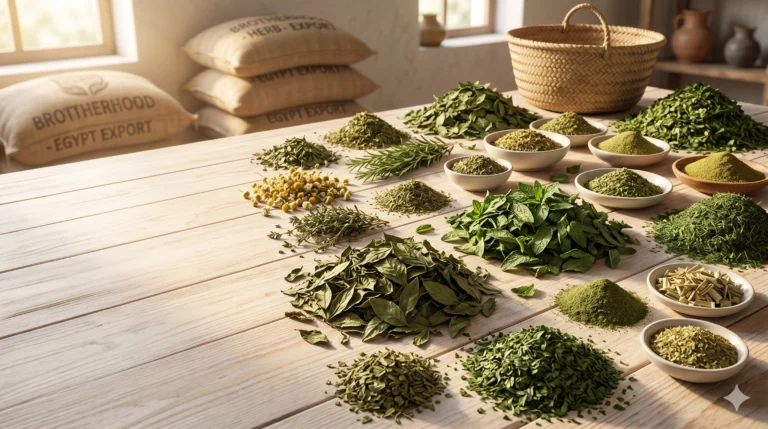
Explore our Egyptian products
Frequently asked questions
Do dried herbs and spices from Egypt need a phytosanitary certificate for the EU?
Phytosanitary certificates apply to the plants and plant products listed in Annex XI of Regulation (EU) 2019/2072. Austria's phytosanitary service and the CBI describe the controls as concerning fresh plant material and seeds for sowing, with dried products covered by food law. The answer depends on the product's customs code, so confirm it with your customs broker before shipping.
Are Egyptian herbs under increased border checks?
In the Egyptian entries of Regulation (EU) 2019/1793 as amended by 2026/1206 that we reviewed, no herb or spice is listed. The list is updated regularly, so check the current annex before each shipment.
Which contaminant limits apply?
Regulation (EU) 2023/915 sets limits such as ochratoxin A (10.0 µg/kg for dried herbs and 15 µg/kg for most dried spices) and pyrrolizidine alkaloids (for example 400 µg/kg for dried herbs in general and for cumin, and 1,000 µg/kg for oregano and marjoram). See the table in Step 4.
Does the importer need to be registered?
Yes. The importer is a food business operator and must notify the competent authority of each establishment so that it can be registered (Regulation (EC) No 852/2004, Article 6).
Which language must the label use?
A language easily understood by the consumers where the food is marketed. Member States may require their official languages (Regulation (EU) No 1169/2011, Article 15).
Is there a duty advantage for Egyptian goods?
Egyptian-origin goods can benefit from the EU–Egypt Association Agreement, provided the Euro-Mediterranean rules of origin are met. Duty rates depend on the customs code, so check Access2Markets.
What extra steps apply in Poland?
For food not covered by EU increased controls, Polish law requires an application for a border sanitary check (Article 79 of the 2006 Food Safety Act), registration of the import activity with the sanitary inspection, and commercial-quality control by IJHARS.
Ready to source from Egypt?
Tell us the products and destination, and we will come back to you with a quotation.
Request a QuoteAbout Brotherhood Herbs